Liberation Day in Berlin
Liberation Day in Berlin is held on May 8. This event in the first decade of the month May is annual.  Help us
Help us 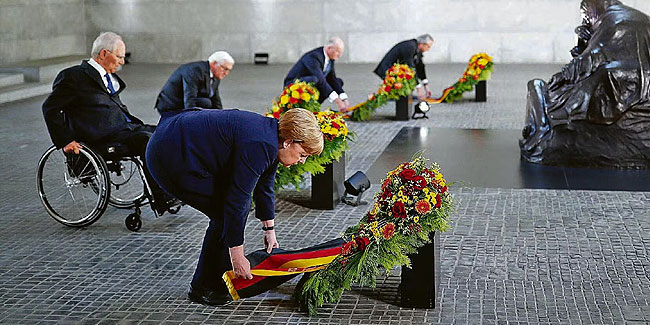
Liberation Day in Berlin on May 8 marks the end of National Socialist rule in Europe and symbolizes the end of the Second World War. Historically, it is assumed that the unconditional surrender of the German armed forces was agreed in Reims on May 7, 1945 - an agreement that was then formally signed by the Soviet commanders-in-chief in Berlin-Karlshorst in the early hours of May 8. This moment not only ended the fighting, but also initiated a profound process of confrontation and remembrance, in which Berlin became the central scene of liberation.
In Berlin today, this day is celebrated with a wide range of commemorative events that encompass both cultural and historical dimensions. To mark the 80th anniversary of the end of the war, for example, the city is offering an extensive themed program: there are exhibitions, film series, theater performances, lecture series, guided tours to important historical sites and interactive projects that bring the past to life. The open-air exhibition at Pariser Platz plays a central role in this, with photographs, eyewitness accounts and artistic installations - such as the “Liberation” sound installation at the Brandenburg Gate - supporting the process of remembrance and giving visitors an intensive approach to history.
The change in meaning of May 8 is another central feature of the event. While in the immediate post-war period it was primarily perceived as a date of military defeat and political upheaval - and was celebrated as an official holiday in the GDR - the culture of remembrance in the Federal Republic of Germany has developed since the 1980s to interpret the day as the beginning of the liberation process from National Socialist tyranny. In particular, this commemorates the countless people who suffered under the Nazi regime and creates a broad social appeal to keep the memory alive and draw lessons for the future.
The day should also be seen as an opportunity to pay tribute to the victims of National Socialism - from forced laborers to the survivors of concentration camps. Despite the liberation, the end of the war did not immediately bring an end to the suffering, which is reflected in many reports and commemorative events. The numerous reappraisal projects and educational initiatives that take place in Berlin during the days of liberation help to anchor the culture of remembrance in public discourse and convey a critical awareness of history to future generations.
In addition to the official commemorations, there are also numerous cultural and social events that promote dialog about responsibility, freedom and history. The variety of events - from artistic performances to academic discussions - shows how Liberation Day in Berlin has become a lively forum for remembrance and reflection. These events not only encourage people to reflect on the past, but also create space for debates on the values of freedom and democracy, which is particularly important in view of the current social challenges.
Similar holidays and events, festivals and interesting facts
 Lingen Spring Fair on May 7
 Donatus May Fair in Euskirchen on May 7
 Rheydter Frühkirmes in Mönchengladbach on May 7
 Anniversary of the liberation from National Socialism on May 8
 Brothers Grimm Festival in Hanau on May 8
 Dillingen Arts and Crafts Market on May 8
 Fair in Schmelz-Michelbach on May 8
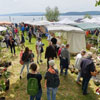 Herb Weeks on Western Lake Constance on May 8
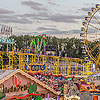 Maidult in Regensburg on May 8
 Mother’s Day on May 9 (Anguilla, Antigua and Barbuda, Aruba, Australia, Austria, Bahamas, Bangladesh, Barbados, Belgium, Belize, Bermuda, Bhutan, Bonaire, Botswana, Brazil, Brunei, Canada, Cambodia, Cayman Islands, Central African Republic, Chad, Chile, China, Colombia, Congo, Dem. Rep., Congo, Rep., Cote d'Ivoire, Croatia, Cuba, Curaçao, Cyprus, Czech Republic, Denmark, Dominica, Ecuador, Equatorial Guinea, Estonia, Ethiopia, Faroe Islands, Fiji, Finland, Germany, Gabon, Gambia, Greenland, Ghana, Greece, Grenada, Guyana, Honduras, Hong Kong, Iceland, India, Italy, Jamaica, Japan, Kenya, Latvia, Liberia, Liechtenstein, Macau, Malaysia, Malta, Myanmar, Namibia, Netherlands, New Zealand, Pakistan, Papua New Guinea, Peru, Philippines, Puerto Rico, Saint Kitts and Nevis, Saint Lucia, Saint Vincent and the Grenadines, Samoa, Singapore, Sint Maarten, Slovakia, South Africa, Sri Lanka, Suriname, Switzerland, Taiwan, Tanzania, Tonga, Trinidad and Tobago, Turkey, Uganda, Ukraine, United States, Uruguay, Vietnam, Venezuela, Zambia, Zimbabwe);
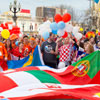 Europe Day on May 9 (is the name of two annual observance days, 5 May by the Council of Europe and 9 May by the European Union, which recognize the peace and prosperity within Europe that both have achieved since their formation);
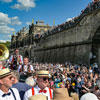 International Dixieland Festival Dresden on May 9 (starts on the second Sunday in May, but sometimes the date can vary);
 Genusszeit in Saarbrücken on May 9 (starts on the second Sunday in May)
 Free Holiday Calendar widgets for websites