
Holiday Calendar for India in November

India is a land of unity in diversity. Indian Culture and traditions are something which has now become renowned all across the world is full of several unique customs and traditions, which outsiders might find really intriguing. India sees a large number of festivals, mainly because of the prevalence of diverse religions and groups. Indian traditions, notable events, festivals, special days and national holidays in India  Help us
Help us National traditions, public holidays and notable observances for 2025-2026 year
November 2025
Saturday 1 November - Chavang Kut (Mizo people of Northeast India, Bangladesh, Burma); Haryana Foundation Day (Haryana, India); Karnataka Rajyotsava (Karnataka, India); Kerala Foundation Day (Kerala, India); Chhattisgarh Rajyotsava or Chhattisgarh Foundation Day in India
Friday 7 November - Tokhu Emong (Lotha Naga people of India)
Friday 14 November - Bal Diwas in India (celebrated on the birthday of Jawaharlal Nehru. Children's Day)
Wednesday 26 November - Constitution Day in India; National Milk Day in India; World Day Against the Indiscriminate Use of Agrochemicals
December 2025
Saturday 6 December - Sindhi Cultural Day (Celebrated on the first Sunday in December. Sindhi diaspora)
Sunday 14 December - National Energy Conservation Day in India (since 1991); World Energy Conservation Day
Tuesday 23 December - Kisan Diwas (Uttar Pradesh, India)
January 2026
Monday 5 January - Birth of Guru Gobind Singh (The occasion is celebrated by Sikhs and Sikh diasporas all over the world)
Friday 9 January - Non-Resident Indian Day (India)
Saturday 10 January - World Hindi Day (Vishwa Hindi Diwas)
Tuesday 13 January - Lohri (Punjab, Haryana, Himachal Pradesh)
Thursday 15 January - Army Day in India; Thai Pongal, Tamil harvest festival in India; Jallikattu in the Indian state of Tamil Nadu (is a traditional spectacle in which a bull, such as the Pulikulam or Kangayam breeds, is released into a crowd of people, and multiple human participants attempt to grab the large hump on the bull's back with both arms and hang on to it while the bull attempts to escape)
Monday 19 January - Kokborok Day (Tripura, India)
Friday 23 January - Netaji Subhas Chandra Bose's Jayanti (Orissa, Tripura, and West Bengal, India)
Saturday 31 January - Amartithi (Meherabad, India, followers of Meher Baba)
February 2026
Saturday 14 February - Parents' Worship Day in India (Hindi: मातृ-पितृ पूजन दिवस as an alternative to Valentine's Day)
March 2026
Tuesday 3 March - Phaghwa (or Holi Phagwa is considered as the famous Hindu spring festival and has got many names as per the region and the community like its knwon as Phaghwa in Bhojpuri and in west Bengal, it is known as Dolyatra)
April 2026
Tuesday 14 April - Ambedkar Jayanti in India; Mahl New Year or Alathu Aharudhuvas (Maldives and India's Lakshadweep and Kerala state)
Saturday 18 April - Hindi New Year (date for 2026)
Thursday 23 April - Khongjom Day (Manipur, India)
Tuesday 28 April - Lawyers' Day (Odisha, India)
May 2026
Friday 1 May - Gujarat Day in India (commemoration of the states of Maharashtra and Gujarat following the foundation of Samyukta Maharashtra Samiti)
Sunday 10 May - Mother’s Day (Anguilla, Antigua and Barbuda, Aruba, Australia, Austria, Bahamas, Bangladesh, Barbados, Belgium, Belize, Bermuda, Bhutan, Bonaire, Botswana, Brazil, Brunei, Canada, Cambodia, Cayman Islands, Central African Republic, Chad, Chile, China, Colombia, Congo, Dem. Rep., Congo, Rep., Cote d'Ivoire, Croatia, Cuba, Curaçao, Cyprus, Czech Republic, Denmark, Dominica, Ecuador, Equatorial Guinea, Estonia, Ethiopia, Faroe Islands, Fiji, Finland, Germany, Gabon, Gambia, Greenland, Ghana, Greece, Grenada, Guyana, Honduras, Hong Kong, Iceland, India, Italy, Jamaica, Japan, Kenya, Latvia, Liberia, Liechtenstein, Macau, Malaysia, Malta, Myanmar, Namibia, Netherlands, New Zealand, Pakistan, Papua New Guinea, Peru, Philippines, Puerto Rico, Saint Kitts and Nevis, Saint Lucia, Saint Vincent and the Grenadines, Samoa, Singapore, Sint Maarten, Slovakia, South Africa, Sri Lanka, Suriname, Switzerland, Taiwan, Tanzania, Tonga, Trinidad and Tobago, Turkey, Uganda, Ukraine, United States, Uruguay, Vietnam, Venezuela, Zambia, Zimbabwe); World Poultry Day
Thursday 21 May - Day of struggle against terrorism in India (commemorated on the anniversary of the death of the seventh Prime Minister Rajiv Gandhi as a result of the terrorist act); International Tea Day
June 2026
Thursday 4 June - Birthday of Bhagat Puran Singh (holiday and memorial day of Sikhs, representatives of the monotheistic religion founded in the Punjab in India in the 15th century. Bhagat Puran Singh [1904-1992] in his youth decided to devote his life to selfless service to humanity)
Sunday 21 June - Father's Day (Сelebrated on the third Sunday of June шт Argentina, Aruba, Canada, Costa Rica, France, Greece, Hong Kong, Hungary, India, Ireland, Kenya, Japan, Macao, Malaysia, Malta, Mexico, Netherlands, Pakistan, Peru, Puerto Rico, Singapore, Slovakia, South Africa, Sri Lanka, Trinidad and Tobago, Turkey, Venezuela, United Kingdom)
Saturday 27 June - Guru Puja Holiday (Hinduism. Guru Puja or the tradition of honoring your teacher is the main and simplest yoga puja. It is performed in the morning and evening)
July 2026
Wednesday 1 July - Doctors' Day in India; The first day of Van Mahotsav in India (celebrated until July 7. Van Mahotsav is an annual tree-planting movement in India, which began in 1950. The name Van Mahotsava means FESTIVAL OF FORESTS); State Bank of India Day
Saturday 4 July - The first evening of Dree Festival (Apatani people, Arunachal Pradesh, India; celebrated until July 7)
Saturday 11 July - Engineer's Day in India, Telangana (The Telangana state celebrates Engineers day on July 11th on the birthday of Ali Nawaz Jung Bahadur)
Thursday 16 July - Ratha Yatra (Held on the second day of Shukla Pakshi of the Hindu lunar month of Ashadha)
Friday 17 July - U Tirot Sing Day (Meghalaya, India)
Friday 31 July - Martyrdom Day of Shahid Udham Singh (Haryana and Punjab, India)
August 2026
Monday 3 August - Stephen (Discovery of the relic. Christian feast day)
Wednesday 12 August - National Librarian's Day in India (in remembrance of national professor of library science, Dr S R Ranganathan [1892-1972], who had spearheaded library development in India)
Saturday 15 August - India Independence Day (is celebrates the independence of India from the United Kingdom in 1947)
Saturday 22 August - Madras Day (Chennai and Tamil Nadu, India)
September 2026
Friday 4 September - Janmashtam (commemoration of the birth of Krishna)
Saturday 12 September - World Headache Day (A Day of Awareness and Support)
Monday 14 September - Hindi Divas (Hindi-speaking regions)
Tuesday 15 September - Engineer's Day in India (The Engineering Community across India is celebrating Engineers Day on 15 September every year as a remarkable tribute to the greatest Indian Engineer Bharat Ratna Mokshagundam Visvesvaraya [popularly known as Sir MV]. He is held in high regard as a pre-eminent engineer of India. "Engineering for A Healthy Planet" is the theme of Engineers Day 2021); Ganesha Festival
Thursday 17 September - Marathwada Liberation Day (Maharashtra, India)
Sunday 27 September - National Daughters Day in India (is celebrated on the 4th Sunday of September every year); International Daughters' Day (Celebrated on the fourth Sunday of September)
October 2026
Friday 2 October - Gandhi Jayanti in India (Gandhi's birthday-related observances)
Monday 12 October - Dashain (is celebrated by the Buddhist, Hindus and Kirats of Nepal and the ethnic Nepali speaking Indian Gorkhas of Darjeeling hills, Sikkim, Dehradun, Kumaun & Gadwal and other North-Eastern states of India and among the Lhotshampa of Bhutan and the Burmese Gurkhas of Myanmar)
Monday 26 October - Accession Day (Jammu and Kashmir, India)
Friday 30 October - Thevar Jayanthi (Thevar community, India)
Also about some indian traditions
We all refer to India and its culture as something very diverse and unique. The namaste is one of the most popular Indian customs is one of the five forms of traditional greetings one another with it is a way of saying "May our minds meet". Indian food and cuisine not only form an integral part of Indian culture but are also one of the key factors of India’s popularity worldwide. Wazwan is less a cuisine and more a tradition among Kashmiris. It is art served on a traem (platter) that involves a 36-course meal.
Chhau Dance: another important tradition from India that made it to UNESCO’s list of Intangible Cultural Heritage of Humanity in 2010 is the classical Chhau dance, from Odisha. In 2013, Sankirtana dance was inscribed in UNESCO’s list of Intangible Cultural Heritage of Humanity. A Pung Cholom dance, which is part of the Sankirtana tradition.
The Festival Nag Panchami usually falls during the months of July and August. In Hindu culture, serpent blessings are sought to bring peace and welfare to the family.
Cow, in the Indian culture, is considered to be a Holy animal. Killing the cow or consuming cow meet is considered to be a sin.
In India, there exists the concept of a joint family, wherein the entire family (parents, wife, children and in some cases relatives) all live together. Faith, family and castes shape just about every aspect of Indian culture - from birth to death - and all the trials and parties in between.
Chhau Dance: another important tradition from India that made it to UNESCO’s list of Intangible Cultural Heritage of Humanity in 2010 is the classical Chhau dance, from Odisha. In 2013, Sankirtana dance was inscribed in UNESCO’s list of Intangible Cultural Heritage of Humanity. A Pung Cholom dance, which is part of the Sankirtana tradition.
The Festival Nag Panchami usually falls during the months of July and August. In Hindu culture, serpent blessings are sought to bring peace and welfare to the family.
Cow, in the Indian culture, is considered to be a Holy animal. Killing the cow or consuming cow meet is considered to be a sin.
In India, there exists the concept of a joint family, wherein the entire family (parents, wife, children and in some cases relatives) all live together. Faith, family and castes shape just about every aspect of Indian culture - from birth to death - and all the trials and parties in between.
All Saints’ Day in Louisiana

All Saints’ Day, also known as All Hallows, Day of All the Saints, Solemnity of All Saints, or Feast of All Saints is a festival celebrated on 1..→
 Remind me of this day Remind me of this day
|
D. Hamilton Jackson Day in U.S. Virgin Islands

David Hamilton Jackson (1884-1946) was a United States Virgin Islands civil rights leader. At the time of his birth, the Territory was under the..→
|
Remind me of this day
|
List of commemorative months in November in Ohio

Epilepsy awareness month; Omega psi phi month; Complex Regional Pain Syndrome Awareness Month and Alpha-1 Antitrypsin Deficiency Awareness Month..→
|
Remind me of this day
|

|
Remind me of this day
|
All Souls’ Day in Guam

All Souls’ Day, in Christianity, is a day commemorating the faithful departed, in particular but not exclusively one’s relatives. In Western Chr..→
|
Remind me of this day
|
International Day to End Impunity for Crimes against Journalists

In 2014, 61 journalists lost their lives as a result of their profession. More than 137 journalists have been killed in the OSCE region since 19..→
|
Remind me of this day
|
Citizenship Day in Northern Mariana Islands

Citizenship means to be a member of a nation or country, and to have full rights and responsibilities under the law. In the United States there ..→
|
Remind me of this day
|
Election Day or Democracy Day

Election Day in the United States is the day set by law for the general elections of public officials. It occurs on the Tuesday right after the ..→
|
Remind me of this day
|
World Tsunami Awareness Day

Recalling the Sendai Declaration and the Sendai Framework for Disaster Risk Reduction 2015–2030, adopted at the Third United Nations World Confe..→
|
Remind me of this day
|
International Day for Preventing the Exploitation of the Environment in War and Armed Conflict

Though mankind has always counted its war casualties in terms of dead and wounded soldiers and civilians, destroyed cities and livelihoods, the ..→
|
Remind me of this day
|
World Town Planning Day (World Urbanism Day)

The international organisation for World Urbanism Day, also known as "World Town Planning Day", was founded in 1949 by the late Profes..→
|
Remind me of this day
|
International Day Against Fascism and Antisemitism

After the Nazis came to power in Germany in 1933, Jews were subjected to increasingly discriminatory treatment accompanied by organised violence..→
|
Remind me of this day
|
International Guinness World Records Day

Guinness World Records, known from its inception in 1955 until 1998 as The Guinness Book of Records and in previous U.S. editions as The Guinnes..→
|
Remind me of this day
|
Armed Services, Peace Officer, First Responder, and Dual Service Recognition Day in Ohio

Every day we are blessed to live in a free land where someone is always looking out for our safety. Peace and freedom are something we don’t hav..→
|
Remind me of this day
|
Barack Obama Day in Perry County, Alabama

In central Alabama’s Perry County, government workers already get a day off for President’s Day, Martin Luther King Day, and Veterans Day. In 20..→
|
Remind me of this day
|
World Science Day for Peace and Development

How many bones are in your body? Did you know that there are 206 bones in the adult human body and there are 300 in children. The human eye blin..→
|
Remind me of this day
|
Armistice Day in Mississippi (Veterans Day)

The Legislature has designated the eleventh day of November as the day for the observance of Armistice Day (VETERANS DAY) , and under the provis..→
|
Remind me of this day
|

|
Remind me of this day
|

World Pneumonia Day

Pneumonia kills more children under the age of five than any other disease, claiming a young life every 20 seconds. That’s 4,300 young lives los..→
|
Remind me of this day
|
World Quality Day

The CQI’s first World Quality Day conference took place on 13 November 2008 at the Imarsat Conference Centre in London and proved to be the foru..→
|
Remind me of this day
|
World Usability Day

On the second Thursday of November, organizers create a single day of events occurring around the world that brings together communities of prof..→
|
Remind me of this day
|
World Diabetes Day

Facts about diabetes: There is an emerging global epidemic of diabetes that can be traced back to rapid increases in overweight, obesity and phy..→
|
Remind me of this day
|
International Day for Tolerance

He that is slow to anger is better than the mighty; and he that ruleth his spirit than he that taketh a city. (Proverbs 16:32)
In 1996, the UN ..→
|
Remind me of this day
|
World Day of Remembrance for Road Traffic Victims

About 1.25 million people die each year as a result of road traffic crashes. Road traffic injuries are the leading cause of death among young pe..→
|
Remind me of this day
|
International Students’ Day

International Students’ Day is an international observance of student community, held annually on November 17. Originally commemorating the Nazi..→
|
Remind me of this day
|
George Rogers Clark Day in Ohio

Lt. Col. George Rogers Clark and his frontiersmen captured Fort Sackville from British Lt. Governor Henry Hamilton and his soldiers on February ..→
|
Remind me of this day
|
International Men’s Day

If you find dirty socks and underwear near-to or semi-near the hamper, there is a man nearby. Men like gadgets with lots of fancy shiny black bu..→
|
Remind me of this day
|
Puerto Rican Culture and Puerto Rico Discovery Day

Celebration of Puerto Rican Culture and Puerto Rico Discovery Day is connected with the fact of discovery of the land by Christopher Columbus in..→
|
Remind me of this day
|

|
Remind me of this day
|
World Toilet Day

More People In The World Have Mobile Phones Than Toilets. Mobile phones have 18 times more bacteria than toilet handles. Americans spend 5 cents..→
|
Remind me of this day
|
Africa Industrialization Day

Understanding Africa and understanding the whole context surrounding the crisis the continent has been through for decades is crucial to deciphe..→
|
Remind me of this day
|
Great American Smokeout

Every year, on the third Thursday of November, smokers across the nation take part in the American Cancer Society Great American Smokeout. They ..→
|
Remind me of this day
|
Universal Children’s Day
Mankind owes to the child the best it has to give - UN Declaration of the Rights of the Child. Worldwide, the average woman gives birth to an es..→
|
Remind me of this day
|
World Philosophy Day

It was around 470 BC when Socrates was born in Athens, Greece. According to Xenophon, Socrates was far more interested in intellectual upbringin..→
|
Remind me of this day
|
World Fisheries Day

This Day celebrations serve as an important reminder that we must focus on changing the way the world manages global fisheries to ensure sustain..→
|
Remind me of this day
|

World Television Day

In 1997, a monkey was arrested in the African state of Benin for stealing a television aerial. It has been calculated that the average American ..→
|
Remind me of this day
|
Adoption day in Ohio
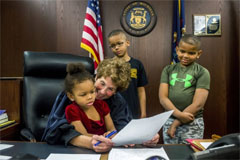
The Saturday immediately preceding Thanksgiving day is designated as "Adoption Day."
(ORC 5.2259 Adoption day. Effective Date: 2008 S..→
|
Remind me of this day
|
International Day for the Elimination of Violence against Women

By resolution 54/134 of 17 December 1999, the United Nations General Assembly designated 25 November as the International Day for the Eliminatio..→
|
Remind me of this day
|
Day before Thanksgiving in Virginia (noon)

The first documented thanksgiving services in territory currently belonging to the United States were conducted by Spaniards and the French in t..→
|
Remind me of this day
|
Thanksgiving Day

Thanksgiving Day (Thanksgiving) is an important public holiday, celebrated by Americans on the fourth Thursday in November. One of the four most..→
|
Remind me of this day
|
Day after Thanksgiving or Black Friday (shopping)

Thinking about shopping women appear almost as often as men in thinking about sex. 74% of women admitted that they think about shopping every mi..→
|
Remind me of this day
|
Family Day in Nevada

Until the late 17th century, ‘family’ included not only relatives but also the servants of a household. The word derives from the Latin ‘famulus..→
|
Remind me of this day
|
Native American Heritage Day in Maryland

In 1990, former President George H.W. Bush approved a Joint Resolution of Congress designating November as National American Indian Heritage Mon..→
|
Remind me of this day
|
Presidents’ Day in New Mexico (Lincoln’s Birthday)

Some states observe the day as part of Presidents’ Day, which is officially known as Washington’s Birthday.
Although Lincoln’s birthday, Februa..→
|
Remind me of this day
|
Robert E. Lee’s Birthday in Georgia

Robert Edward Lee, who would become known as one of the most brilliant military commanders in American history, was born to Revolutionary War he..→
|
Remind me of this day
|
International Day of Solidarity with the Palestinian People

Where did the name come from? In an effort to rid Judea of its Jewishness, the Romans renamed the area Filistia (Palestine) in the mid-130s CE. ..→
|
Remind me of this day
|
